This page was created by Ashley Cirimeli. The Primary focus of this page is on Borzoi but I will include some Silken Windhound examples too. These two breeds have a fantastic rainbow of colors in their respective gene pools. I have put together this page as a reference/guide for anyone interested in the magic of color genetics.
If you learn something, consider buying me a cup of coffee!
First and foremost, this page will use genetic color terms as opposed to breed color terms. There has been some confusion with the varying names (grizzle vs sable vs sabled, for example). Below is a chart that will list genotype, breed term, and genetic term. Where a genetic term for a specific color combo doesn’t exist, breed terms will be used instead. When we say "sable", we are speaking of the Ay allele (think collies and shelties), not Eg modifying Black and Tan (what borzoi folks call Sable).
| Genotype | Genetic Term | Borzoi/Silken Term |
|---|---|---|
Genetic Jargon Explained
As you read this page, you'll see a lot of words that may be unfamiliar, like homozygous, allele, locus, dominant, etc. Here is a handy guide to help!
Locus: A locus refers to the location on the chromosome where the gene is found. Example: black and tan, at/at is on the A locus
Allele: Alleles are variants of the same gene that occur on the same place on a chromosome. Example: at/at, Ay, and aw are all alleles on the A locus.
Homozygous/Heterozygous: Zygosity is the degree of similar traits in an organism. The prefixes homo and hetero respectively mean same and different. Example: at/at is homozygous whereas Ay/at is heterozygous.
Eumelanin: Black pigment
Phæomelanin: Red pigment
Dominant/Recessive: Brindle for example, is a dominant allele, meaning a dog only needs one copy of the allele in order to express the color/pattern (Kbr/-). Black and tan is a recessive allele; a dog needs two copies in order to express black and tan (at/at). We use capitals and lower case letters to differentiate between dominant and recessive alleles. On the A locus, at, aw, and a are recessive while Ay is dominant.
There is also a hierarchy of dominant and recessive alleles on each locus. On the K locus, both dominant black (KB) and brindle (Kbr) are dominant alleles-- the dog only needs one copy to express the color/pattern. However, what happens when a dog is KB/Kbr? Both are dominant alleles, but KB is dominant to Kbr, therefore the dog will be black.
Genotype: The genetic constitution of an organism.
Phenotype: The observable characteristics of an organism.
Color Guide
Dogs contain two pigments that influence their color: Eumelanin (black) and Phæomelanin (red). There are genes that can modify/dilute these pigments to look like a whole host of other colors (silver, liver, blue, etc.). White isn’t a pigment, but rather the absence of pigment.
It’s easy to comprehend canine colors when thinking about them in terms of layers. White is the top most layer, then black, then red. White hides all, black hides red. Think of white like a blanket that falls on top of everything else. Holes in the white (caused by any number of genes such as piebald or ticking) will show the color that exists underneath. Sometimes that white blanket is small and only shows up as a few hairs on the chest, or a blotch over the toes. Sometimes it covers the entire dog.
Similarly, holes/breaks in black will reveal the red underneath (black and tan, brindle, etc.).


The color of the dog still exists underneath the white! So you will still see the markings underneath if there are holes/breaks (spots) in the white pattern. In this example, you can still see the black and tan markings!
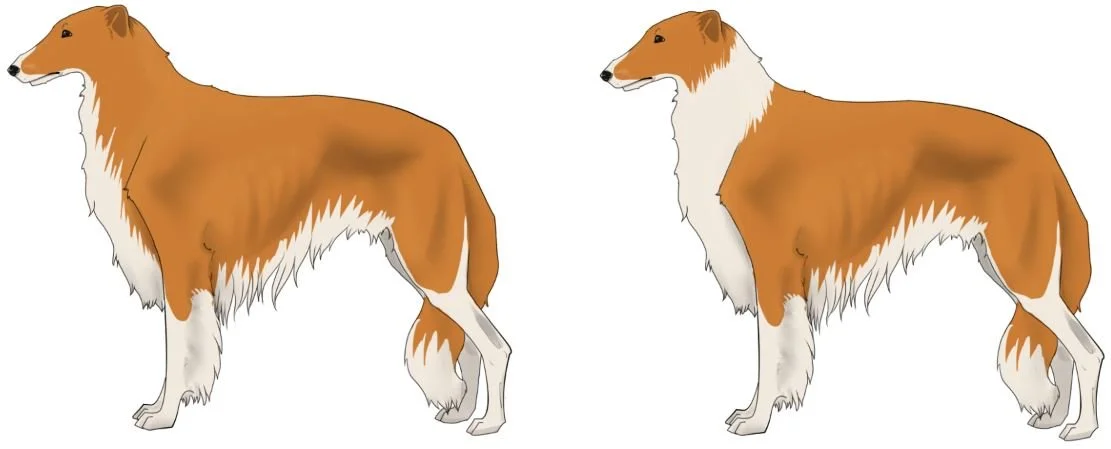


Spotted: Also called “Piebald”. Spotting is mostly random as far as we know, though some lineages seem to produce very similar markings. Heavily spotted dogs can look similar to irish marked dogs. Sometimes the spotting is restricted entirely to around the eyes and ears, often called “extreme white”.
Spotted dogs test as sp/sp.
Irish Marked: This type of white pattern describes a dog who has more white patterning up the legs, undersides, the tip of the tail, and often a partial or complete “collar”.
Most Irish Marked borzoi and silkens test as S/sp, which is often referred to as “Pseudo Irish”. An Irish marked dog who tests as S/S has true irish markings. A dog with one copy of true irish markings, and one copy of spotting (also tests as S/sp) will have much more white coverage, usually a full white collar that connects to a wide blaze on the head, high white legs, and sometimes a spot of white around the hips.
Self: The “Self” descriptor referrs to a mostly solid pigmented dog with minimal white markings, usually caused by residual white. The white is usually on the chest, toes, and tip of the nose. Residual White occurs when pigment doesn't migrate fully as the embryo develops.
Most self dogs test as S/S however, some self dogs also cary for spotting and may test as S/sp. As mentioned above, S/S can also be a result on true irish marked dogs so phenotype will be your best indicator there.
Health concerns: Deafness can be caused by pigment deletion within the inner ear if it reaches the cochlear hairs. Anecdotally, this seems quite uncommon in borzoi but has popped up a few times in silkens, as silkens seem to have more occurances of “white head” and “split face” (unknown genetic markers at this time).
A genome-wide association study of deafness in three canine breeds
STRING data mining of GWAS data in canine hereditary pigment-associated deafness
White Markings
MITF and White Spotting in Dogs: A Population Study
Important Note: Only the sp allele (spotting) has been identified on the S locus, so other white patterns will all test as S/S. This includes true irish markings (often written as Si). If you color test your dog who phenotypes with irish markings but genotypes as S/S, your dog likely has at least one copy of true irish markings!
The ky allele: This is the most recessive allele on the K locus, and does not alter appearance. A dog that is homozygous for ky will not express dominant black or brindle, but instead express whatever other alleles are present on the other color loci. They can still express eumelanin in their coats from the A and E loci.
Brindle: Brindle is a dominant allele, but it is recessive to dominant black. Pheomelanin is expressed where there are breaks in the black pattern, creating a striped look. The width of these breaks can vary. Any allele(s) that dilutes or modifies black or red pigment will alter the color/appearance of the brindle; for example: above right, silver brindle. Genes that modify phæomelanin can similarly alter the look of a brindle dog.
While we write the brindle allele as “Kbr” for ease, every brindle dog will test as “KB/ky” because brindle is the result of a duplication of the KB and ky alleles.
Dominant Black: Because it's a dominant allele, a dog only needs one copy in order to express dominatn black. In most cases, a dog carrying one copy of the Dominant Black allele will only appear black (aside from white patterns). The exceptions to this would be liver (b/b), blue (d/d), sometimes grizzle (eg), recessive red (e/e) and seal (unknown locus/allele). These alleles all modify, dilute, or hide the eumelanin in different ways.
Dominant black tests as KB


The K Locus
The E Allele: This allele does not appear as a specific color or pattern, similar to ky. E is recessive to Em, but dominant to eg and e-- meaning a dog who is E/eg will not show the effects of grizzle and instead will show whatever color/pattern they have on the A locus, and/or K locus. When testing dogs, E is the "process of elimination" allele. When a dog tests negative for Em, Eg, and e, labs will list results as E.
Recessive Red: Also called “recessive yellow”. Recessive Red completely eliminates all black hair pigment except for somatic mutations. Sometimes it can affect the pigment of the skin on the nose, lips, and eyelids too. The intensity of this red can vary from almost white to a rich dark red/brown. It can be tricky to differentiate between recessive red and a grizzle cream or a clear sable. Usually grizzle cream will have dark silver on their ear tips that fades with age, clear sables will have at least some black whiskers, but recessive reds will have no black hairs at all, unless they express somatic mutations.
Recessive Red tests as e/e
Grizzle: Grizzle is not a specific color or pattern but rather an allele that modifies other colors and patterns. It is Recessive to Em, and E, but dominant to e. When paired with eumelanin on the K locus, it seems to fade the color to shades of silver. When paired with the A locus, it seems to restrict the expression of eumelanin markings.
Scroll down to read more about the different grizzle combinations of colors (silver, sivler brindle, classic grizzle, grizzle brindle, grizzle cream/gold).
Mask: The Mask allele is the most dominant on the E locus. Masking describes the eumelanin on the face of the dog. It can range from just a small bit around the nose to a full face. In some breeds, masking can extend beyond the head! This is commonly referred to as “extreme masking”.
Masking tests as Em


The hierarchy of dominance on this allele is as follows: Em, E, eg, e. As far as we know, additional E locus alleles such as eA and eH are not represented in either borzoi or silken gene pools.
The E Locus
The A Locus
The only two alleles on the A locus that exist in Borzoi and Silken Windhoudns are Ay and at. However, UC Davis has updated their A locus reporting to separate Ay into “dominant yellow” (ASIPᵈʸ) and “shaded yellow (ASIPˢʸ), as well as giving saddle it’s own A locus allele as “black saddle” (ASIPᵇˢ). They also report 3 different variants of the at allele as “black back” 1-3 (ASIPᵇᵇ¹, ASIPᵇᵇ², ASIPᵇᵇ³). The hierarchy of dominance in borzoi and silkens is as follows: ASIPᵈʸ, ASIPˢʸ, ASIPᵇˢ, ASIPᵇᵇ¹, ASIPᵇᵇ², ASIPᵇᵇ³. Read more here.
Dominant Yellow: This phenotype can be indistinguishable from recessive red, or grizzle based creams and golds. Dominant yellow is the most dominant allele on the A locus.
Dominant Yellow tests as “Ay” with most labs and ASIPᵈʸ with UC Davis.
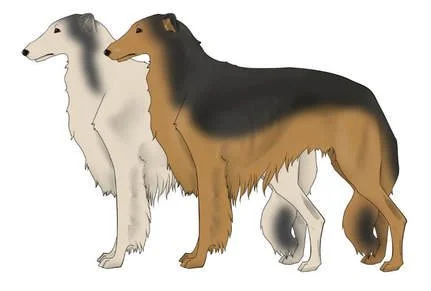
Shaded Yellow: This is the phenotype often called “Sabled” by borzoi and silken folks, that the rest of the dog world calls “sable”. The heavily shaded phenotype can look quite similar to a classic grizzle, though usually the widow’s peak isn’t as strong in a shaded yellow. Sometimes the shading is contained only to the ears, cheeks, and parts of the tail. Shading is recessive to dominant yellow and requires two copies of the allele in order to express.
Dominant Yellow tests as “Ay” with most labs and ASIPˢʸ with UC Davis.
Saddle, Creeping Tan: This phenotype is not present in borzoi from what I have seen, but does occur in Silken Windhounds. The UC Davis genetics lab has assigned Saddle its own allele on the A locus as ASIPᵇˢ for black saddle. They list ASIPᵇˢ as dominant to any of the “black back” alleles so a dog that is ASIPᵇˢ/ASIPᵇᵇ³ will phenotype as saddle. In other labs, they test for the presence of RALY though an at/at dog with two copies of RALY does not always phenotype as a saddle, as is the case with borzoi. As such, I would rely more on the UC Davis test for these breeds.
Saddle tests as ASIPᵇˢ with UC Davis.
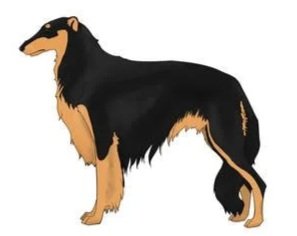
Black and Tan: This phenotype is recessive to either variant of the Ay allele. At birth, puppies appear nearly solid black, especially if they are also brindle, with tan markings expanding as they grow. The tan point markings can be any shade of phæomelanin.
Black and Tan tests as at/at with most labs and ASIPᵇᵇ¹, ASIPᵇᵇ², or ASIPᵇᵇ³ with UC Davis.
Blue/Dilute: Like liver, dilute will affect any eumelanin and dilutes it to a grey color (including nose, eyelid, and lip pigment). Eyes will usually be more of a yellow or tea color. Sometimes the pigment will be dark enough that the dog will appear to be a typical silver. However, in bright sunlight and next to a dog with dark black pigment, it is more noticeable. In some breeds, hair loss is associated with dilute (called Color Dilute Alopecia), but there hasn’t been evidence of this existing in borzoi or silken windhounds. D/D (capital letters) indicates no presence of dilute. Dilute is quite rare in borzoi, and a bit more common in silkens. Confusingly, some dilute silkens look closer to liver with a more brown-ish grey nose, and coat.
Dilute tests as d/d
Liver/Chocolate/Brown: Liver affects any eumelanin and changes it to a red/brown color. Any black skin pigment, such as on the lips, eyelids, and nose leather, will be similarly brown in color. Eyes are typically a more yellow-ish color. B/B (capital letters) indicates no presence of liver, and all pigment will be black. Some have mentioned seeing liver borzoi in the past but I have yet to see evidence of it existing in borzoi. It should be noted that blue dilute can look deceptively like liver on some dogs such as Ay sable. If you have a borzoi or silken that has tested B/b or b/b, please let me know!
Liver tests as b/b

